
The Church Waffle and the Formation of Christlike Character

by Dave Miller
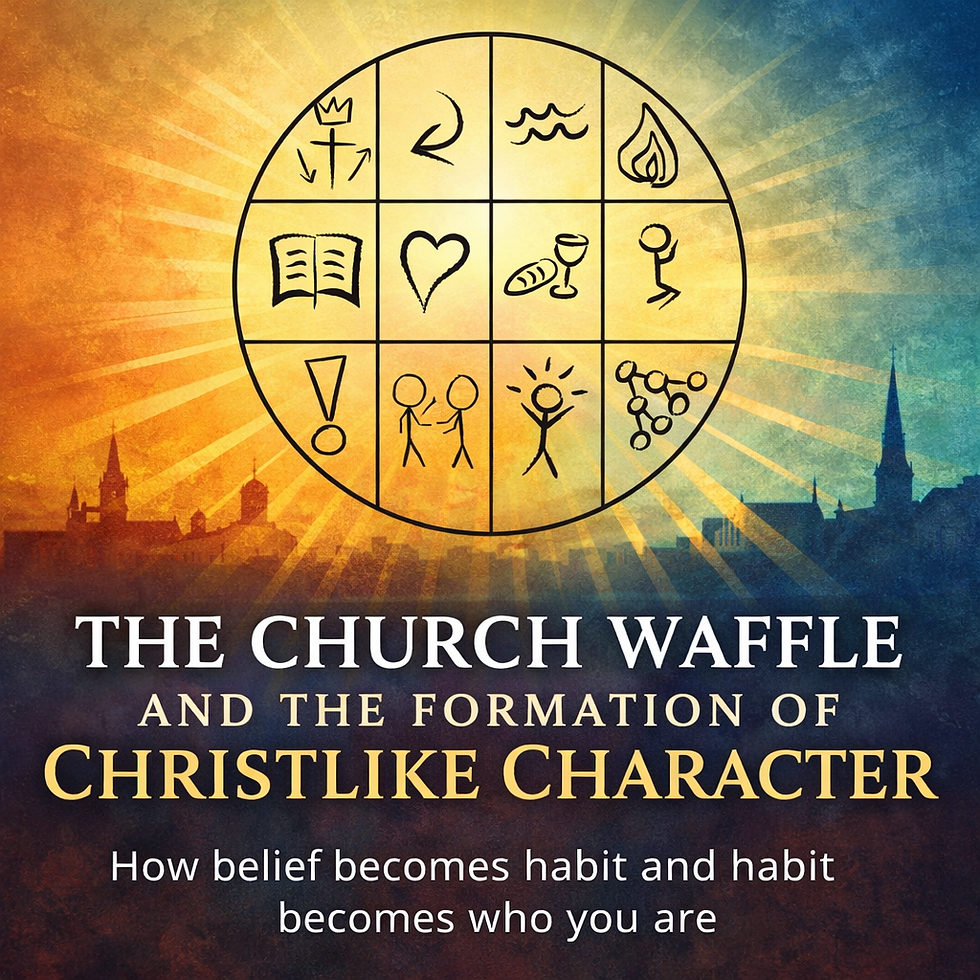
How belief becomes habit and
habit becomes who you are
Most believers do not struggle with whether Jesus is true. They struggle with how to become like Him.
We believe the gospel. We admire Christ. We agree with His teachings. Yet the quiet question remains: how does His life become our life? How does what we believe shape what we actually love, choose, and do when no one is watching?
The answer Scripture gives is not complicated, but it is profound. It is not willpower. It is not moral striving. It is transformation through faithful practice. This is what the Church Waffle makes visible.
The Church Waffle is not just a drawing. It is a picture of how Jesus and the apostles understood spiritual formation. When Luke describes the first believers in Acts 2:36-47, he shows us what a living, growing church actually does. They gathered around the Word. They prayed. They ate together. They cared for one another. They shared their lives. They witnessed publicly. They lived with joy and reverence before God. These were not programs. They were rhythms. Over time, those rhythms shaped how people thought, felt, responded, and lived. The Church Waffle simply organizes those same rhythms into a clear, memorable framework so we can practice them intentionally today.
Christlike character is not primarily revealed in what we do when we are thinking carefully. It is revealed in what we do. Dallas Willard explains that our will is the place where our choices originate, and as we continue making the same kinds of choices, those choices become habits, and those habits gradually become character. In time, what once required effort begins to feel natural. This is deeply hopeful because it means becoming like Christ is not about perfection. It is about direction, repetition, and time. Each small decision to pray, to listen, to forgive, to serve, to worship, and to speak truth gently is a seed. Over months and years, those seeds grow as Christ is with us, into who we are.
Luke shows us this pathway clearly in Acts 2:
“When they heard this, they were pierced to the heart and said to Peter and the rest of the apostles, “Brothers, what should we do? ”
Peter replied, “Repent and be baptized, each of you, in the name of Jesus Christ for the forgiveness of your sins, and you will receive the gift of the Holy Spirit. For the promise is for you and for your children, and for all who are far off, as many as the Lord our God will call.”
With many other words he testified and strongly urged them, saying, “Be saved from this corrupt generation! ”
So those who accepted his message were baptized, and that day about three thousand people were added to them.
They devoted themselves to the apostles’ teaching, to the fellowship, to the breaking of bread, and to prayer. Everyone was filled with awe, and many wonders and signs were being performed through the apostles. Now all the believers were together and held all things in common. They sold their possessions and property and distributed the proceeds to all, as any had need. Every day they devoted themselves to meeting together in the temple, and broke bread from house to house. They ate their food with joyful and sincere hearts, praising God and enjoying the favor of all the people. Every day the Lord added to their number those who were being saved. ”
Acts 2:37-47 CSB
When Peter finished preaching, people believed. But belief did not remain abstract. It immediately turned into a way of life. They devoted themselves. They stayed close. They shared meals. They prayed. They learned. They served. They rejoiced. This was not religious busyness. It was a training environment for the human heart. The Church Waffle captures that same pathway. Belief leads to decision. Decision leads to practice. Practice leads to habit. Habit leads to character. Over time, Christ moves from being someone we admire to someone we naturally reflect.
This works because God is not merely interested in our obedience. He desires that we become people who want what He wants. That kind of transformation cannot be forced. It must be freely chosen and patiently formed. Our ability to choose is precious because it is the place where faith, hope, and love live. The Church Waffle honors that dignity. It does not pressure us. It invites us into rhythms that quietly reshapes our desire for good.
For those paying attention, the Church Waffle becomes something even more personal. It becomes a Character Waffle. Each part of it trains something within us. The Word forms clarity and truth. Prayer and worship shape a God-centered heart. The table and fellowship grow love and patience. Service and witness develop courage and generosity. These are not separate from daily life. They become the way we live, work, and lead.
This is not a short term spiritual program. It is a lifelong apprenticeship. Over years, the Church Waffle becomes the quiet architecture beneath our lives. It carries us through joy, suffering, success, and loss. Slowly and faithfully, Jesus becomes less just someone we think about and more someone we embody. Not because we tried harder, but because we chose again and again the better way.
At some point, this must move from being a picture of what the church does to a picture of who you we becoming. The Church Waffle was never meant to be a checklist of spiritual activities to keep a people busy. It was given to us as a way of training the whole community, person by person. When we practice these rhythms with intention and faith, they quietly reshape our loves, our instincts, and our responses. Over time, they become the way Christ lives through us.
This is why it is so important to make the Church Waffle your personal Character Waffle. Each part of it trains something deep within you. The Word forms your mind in truth. Prayer and worship tune your heart toward God. The table and fellowship grow your capacity to love. Service and witness develop courage and generosity. Together, they do more than fill your calendar. They shape your soul.
Through these practices, Christ does not remain distant or theoretical. He becomes near and familiar. His patience becomes your patience. His mercy becomes your mercy. His faith becomes your faith. Slowly, the life of Jesus moves from something you admire to something you live.
This is how love, joy, and peace grow in us. Not through pressure, performance, or willpower but through a steady life of faith and hope in the Lord Jesus Christ, practiced day by day in community.
As we give ourselves to these rhythms, we discover that this really is the better way. And in time, it becomes our way.
Songs to meditate on the church waffle stories


Comments