
Made Righteous For Righteousness

by Dave Miller
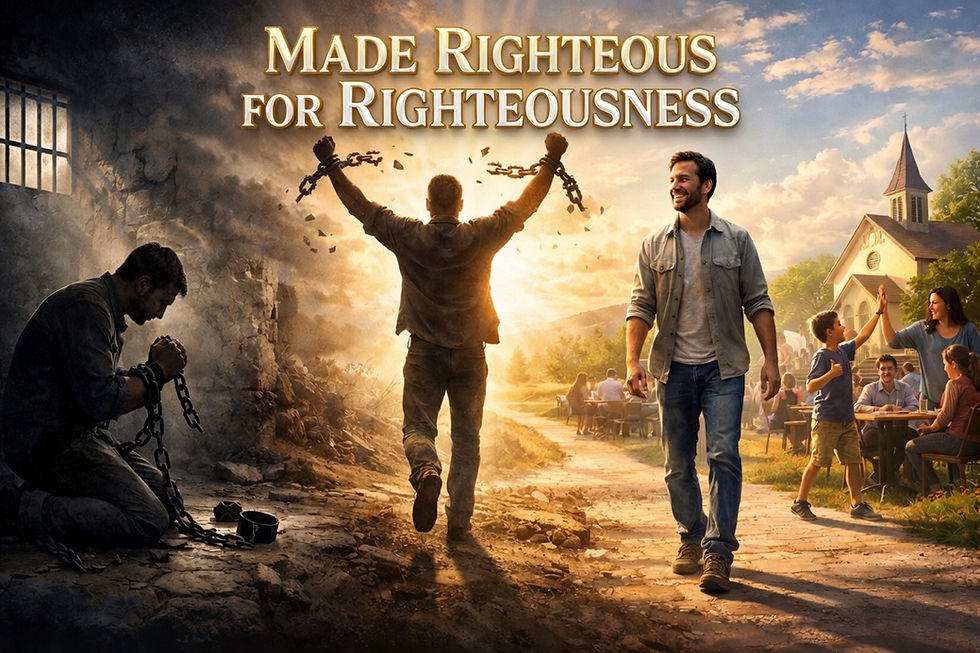
For most of my life, I understood the gospel primarily in courtroom language. Jesus died, was buried, and rose again so that I could receive His righteousness. That understanding is absolutely true. The righteousness that saves us is not our own. It is what theologians often call the alien righteousness of Christ, righteousness that belongs to Him but is credited to us.
The gospel announces that I am a sinner who cannot make myself right before God. No amount of effort, morality, or discipline can erase my guilt. Only Christ can. Through His life, death, and resurrection, Jesus makes it possible for us to be justified, declared righteous before God.
Justification is the starting line of salvation. It is not the finish line.
Once a person is declared righteous, a new question emerges: What are we justified for? What is the purpose of this rescue?
The New Testament consistently answers that question. We are not only saved from something. We are saved for something.
Paul captures this idea in Galatians 5:1: “For freedom, Christ set us free.” That statement immediately raises another question. If we are set free for freedom, then what is freedom actually for?
Freedom is not the absence of restraint. Freedom is the restoration of the ability to live rightly before God.
Paul hints at this when he describes the gospel in Romans as bringing about “the obedience of faith” and as a life that moves “from faith to faith.” Faith is not only the doorway into salvation. It is the path we walk afterward.
Dallas Willard once made a helpful observation about this. We do not only need faith in Jesus. We must also learn to live with the faith of Jesus. In other words, we trust Him for forgiveness, but we also learn to live life the way He lived it.
This leads to a crucial distinction.
We are made righteous for righteousness.
The first righteousness is a declaration. The second is a way of life.
When a person trusts Christ, God declares them righteous. But that declaration is not merely legal language. Scripture teaches that something real happens within us. The Holy Spirit regenerates the heart. The heart of stone becomes a heart of flesh. Our spirit is made alive. Our will is no longer bound to sin in the same way it once was.
Paul explains this transformation in terms of slavery. Before Christ we are slaves to sin. After Christ we are freed from sin so that we can become servants of righteousness. Our master changes.
That change of master reveals the purpose of salvation.
We are not made righteous so that we can simply feel secure about eternity. We are made righteous so that we can live righteously now.
This explains something important about the teaching ministry of Jesus. If you read the Gospels carefully, you notice that Jesus spends relatively little time explaining how justification works. Instead, He spends the vast majority of His time training His disciples how the justified should live. For those familiar with the three circles gospel tool… Jesus spends time helping us how to see, hear, and desire the heart circle more than the other two combined.
The Sermon on the Mount, for example, is not a lecture about how to earn salvation. It is a training manual for people who belong to the kingdom of God. Jesus teaches His followers how to practice humility, mercy, reconciliation, generosity, prayer, trust, and love for enemies.
He is showing them how to live out the righteousness they have received.
This is where a subtle danger emerges in the Christian life. It is very easy to slip from doing right into merely wanting to be right.
When justification becomes the only thing we talk about, discipleship slowly disappears. The gospel becomes an idea to defend rather than a life to follow.
Dietrich Bonhoeffer warned about this danger when he wrote that discipleship cannot exist as an abstract concept. Christ did not call people to follow an idea. He called them to follow Himself. As Bonhoeffer famously argued, Christianity without discipleship is always Christianity without Jesus Christ.
You cannot follow a proposition. You can only follow a person.
When that distinction is lost, Christian communities often drift into two different errors.
One error prioritizes being right above everything else. This is often associated with conservative expressions of Christianity. Truth matters deeply, and the community becomes extremely careful about defending correct doctrine and correct propositions. Yet the life of the community may not reflect the character of Christ. People may have the right answers but display arrogance, harshness, or cruelty toward others. The statements of truth remain correct, but the hearts promoting them remain unchanged.
In this situation, believers are more concerned with being right than doing right.
The other error moves in the opposite direction. Some communities react against harshness and conclude that behavior is the only thing that matters. The emphasis shifts to appearing loving, compassionate, and inclusive. As long as actions seem to resemble what people imagine Jesus might do, the foundation of the gospel is treated as secondary or unnecessary.
Here the concern becomes doing right without first being made right.
But this is a false choice.
The gospel refuses both extremes.
Christian faith begins with the recognition that we cannot make ourselves righteous. Only Christ can make us right before God. Our justification rests entirely on Him.
Yet the same Jesus who justifies us also trains us. He spends the majority of His ministry teaching His disciples how to live in the kingdom of God.
This is the middle ground we must recover.
We learn what is true.
We trust Christ alone to make us right.
Then we grow into lives that increasingly do what is right.
Righteousness begins as a noun. It becomes a verb.
Through Christ we are made righteous, and because of Christ we learn to live righteously.
A Community That Is Both Right and Loving
Our communities desperately need this recovery.
It is possible to build communities that are completely correct in their theology and yet deeply toxic in their behavior. Every doctrine may be carefully defined. Every argument may be logically precise. Yet something is missing. The aroma of people who truly love God and love their neighbor is absent.
Jesus said the defining mark of His followers would not simply be their arguments or their accuracy. He said, “They will know you are my disciples by your love for one another.”
But we must also be careful here, because our culture has begun to redefine love in a way that is just as dangerous.
In many places, love has been reduced to affirmation. If someone desires something, then love supposedly requires everyone else to celebrate and affirm that desire. If you refuse to affirm it, you are accused of being unloving.
This is not biblical love. It is a kind of weaponized empathy.
It quietly assumes that whatever a person wants must therefore be good. And if that desire is good simply because it is desired, then anyone who challenges it becomes the enemy.
In that framework, love becomes little more than a disguised form of self-worship: If I want it, it must be good. If you love me, you must affirm it.
But the gospel refuses this definition of love just as firmly as it refuses harsh, loveless truth.
Real love is rooted in truth. At the same time, real truth must be expressed through love.
A community shaped by Christ can say, “This is the way we should live,” while still remaining a place of patience, forgiveness, humility, and restoration. It does not abandon truth simply to avoid conflict. But it also refuses to treat people with contempt in the name of defending truth.
Jesus never promised a world without offense. In fact, He assumed offense would happen. Much of His teaching is devoted to helping His followers learn how to deal with it—how to forgive, how to reconcile, how to confront sin, and how to restore relationships.
The goal of the Christian life is not merely to win arguments or to maintain appearances. The goal is to become a people whose lives reflect both the truth and the love of Christ.
We want to understand what is right.
We want to be made right through Christ.
And then we want to learn, day by day, how to do what is right together.


Comments